

SSO is available on Enterprise plans.
Configure SSO
Okta
Configure Okta SSO in your Mintlify dashboard
- In your Mintlify dashboard, navigate to the Single Sign-On page.
- Click Configure.
- Select Okta SAML.
- Copy the Single sign on URL and Audience URI.
Create a SAML app in Okta
- In Okta, under Applications, create a new app integration using SAML 2.0.
-
Enter the following from Mintlify:
- Single sign on URL: the URL you copied from your Mintlify dashboard
- Audience URI: the URI you copied from your Mintlify dashboard
- Name ID Format:
EmailAddress
-
Add these attribute statements:
Name Name format Value firstNameBasic user.firstNamelastNameBasic user.lastName
Copy the Okta metadata URL
In Okta, go to the Sign On tab of your application and copy the metadata URL.
Microsoft Entra
Configure Microsoft Entra SSO in your Mintlify dashboard
- In your Mintlify dashboard, navigate to the Single Sign-On page.
- Click Configure.
- Select Microsoft Entra ID SAML.
- Copy the Single sign on URL and Audience URI.
Create an enterprise application in Microsoft Entra
- In Microsoft Entra, navigate to Enterprise applications.
- Click New application.
- Click Create your own application.
- Select “Integrate any other application you don’t find in the gallery (Non-gallery).”
Configure SAML in Microsoft Entra
- In Microsoft Entra, navigate to Single Sign-On.
- Click SAML.
- Under Basic SAML Configuration, enter the following:
- Identifier (Entity ID): the Audience URI from Mintlify
- Reply URL (Assertion Consumer Service URL): the Single sign on URL from Mintlify
Configure Attributes & Claims in Microsoft Entra
- In Microsoft Entra, navigate to Attributes & Claims.
- Select Unique User Identifier (Name ID) under “Required Claim.”
- Change the Source attribute to
user.primaryauthoritativeemail. - Under Additional claims, create the following:
Name Value firstNameuser.givennamelastNameuser.surname
Copy the Microsoft Entra metadata URL
Under SAML Certificates, copy the App Federation Metadata URL.
JIT provisioning
When you enable JIT (just-in-time) provisioning, users who sign in through your identity provider are automatically added to your Mintlify organization.JIT provisioning only works for IdP-initiated login. Users must sign in from your identity provider (Okta dashboard or Microsoft Entra portal) rather than starting from the Mintlify login page.
Enforce SSO-only sign-in
Organization admins can require everyone in the organization to sign in through your identity provider. When SSO enforcement is on, Mintlify rejects password, magic link, and Google OAuth sign-ins.- Navigate to the Single Sign-On page in your dashboard.
- Confirm that SSO is configured and verified end-to-end.
- Toggle Enforce SSO-only sign-in on.
Verified domains
Add domains your organization owns so Mintlify can tie sign-ins and invitations back to a trusted identity. You can add up to five verified domains per organization.- Navigate to the Single Sign-On page in your dashboard.
- In the Verified domains section, click Add domain.
- Enter the domain (for example,
example.com) and click Add. - Mintlify generates a verification token. Add it as a DNS TXT record on the domain.
- Return to the dashboard and click Verify. The status changes from Pending to Verified once the record propagates.
Breakglass emails
Designate emergency-access accounts that can sign in even when SSO enforcement is on or your identity provider is unreachable. Use breakglass emails to recover access if your IdP has an outage or a misconfiguration locks members out.- Navigate to the Single Sign-On page in your dashboard.
- In the Breakglass emails section, add the email addresses of the org members who should retain non-SSO access.
- Click Save changes.
Map RBAC roles with SAML groups
Assign roles to users based on their identity provider group membership. When a user signs in through SSO, Mintlify reads thegroups attribute from the SAML assertion and maps those groups to dashboard roles.
Configure group attribute statements
Add agroups attribute statement to your SAML identity provider configuration. The attribute must use the unspecified name format.
The resulting SAML assertion should include an AttributeStatement.
Example SAML assertion
- The attribute name must be
groups(case-sensitive) - The name format must be
urn:oasis:names:tc:SAML:2.0:attrname-format:unspecified - Each group the user belongs to should be a separate
AttributeValueelement
- Okta
- Microsoft Entra
In your Okta SAML app configuration, add a group attribute statement:
Adjust the filter to match the specific groups you want to send to Mintlify.
| Name | Name format | Filter | Value |
|---|---|---|---|
groups | Unspecified | Matches regex | .* |
Change or remove SSO provider
- Navigate to the Single Sign-On page in your dashboard.
- Click Configure.
- Select your preferred SSO provider or no SSO.
Other providers
For providers other than Microsoft Entra or Okta SAML, contact us to configure SSO.Google Workspace with SAML
Create an application
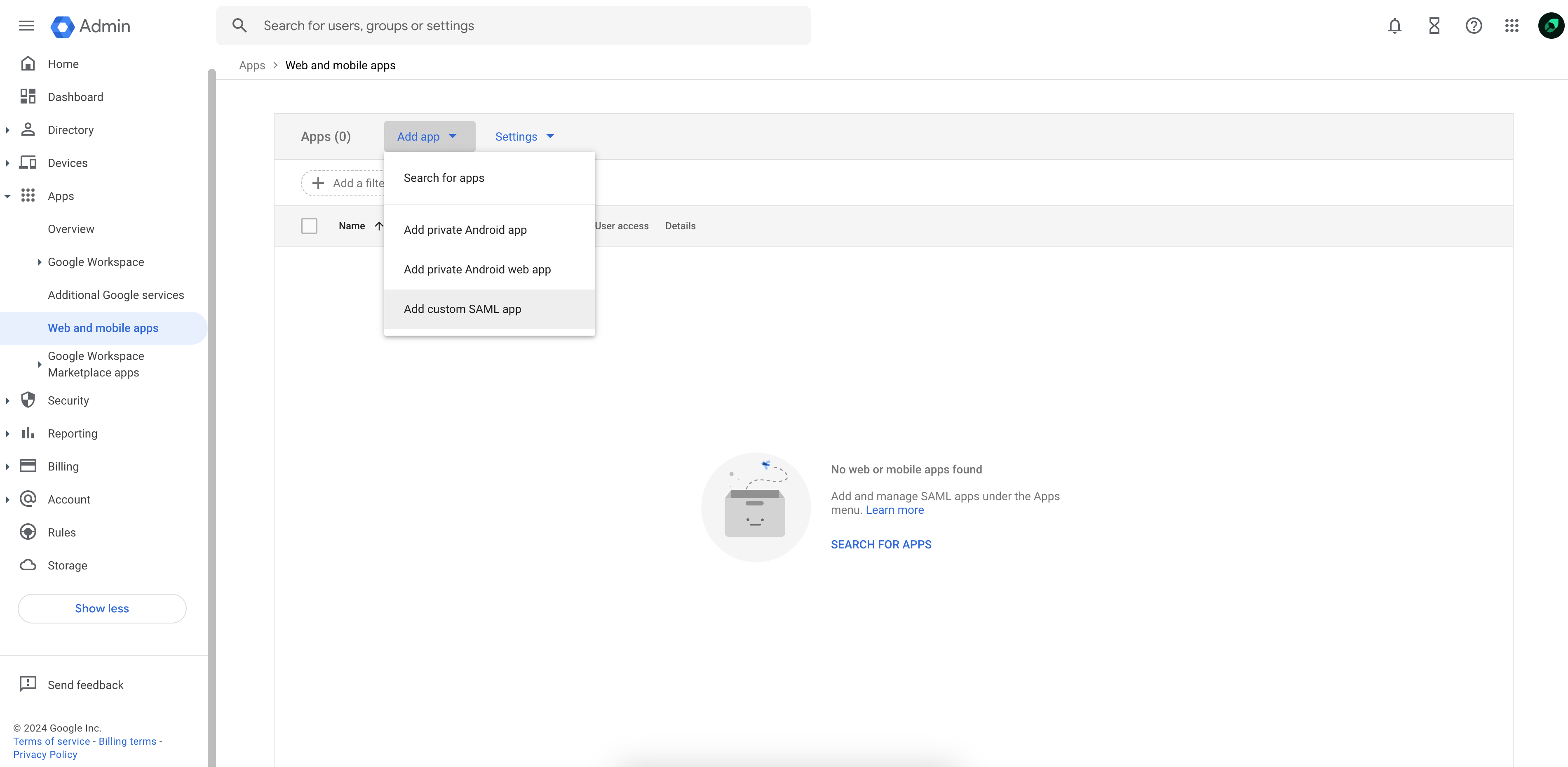
- In Google Workspace, navigate to Web and mobile apps.
- Click Add custom SAML app in the Add app dropdown.
Send us your IdP information
Copy the provided SSO URL, Entity ID, and x509 certificate and send it to the Mintlify team.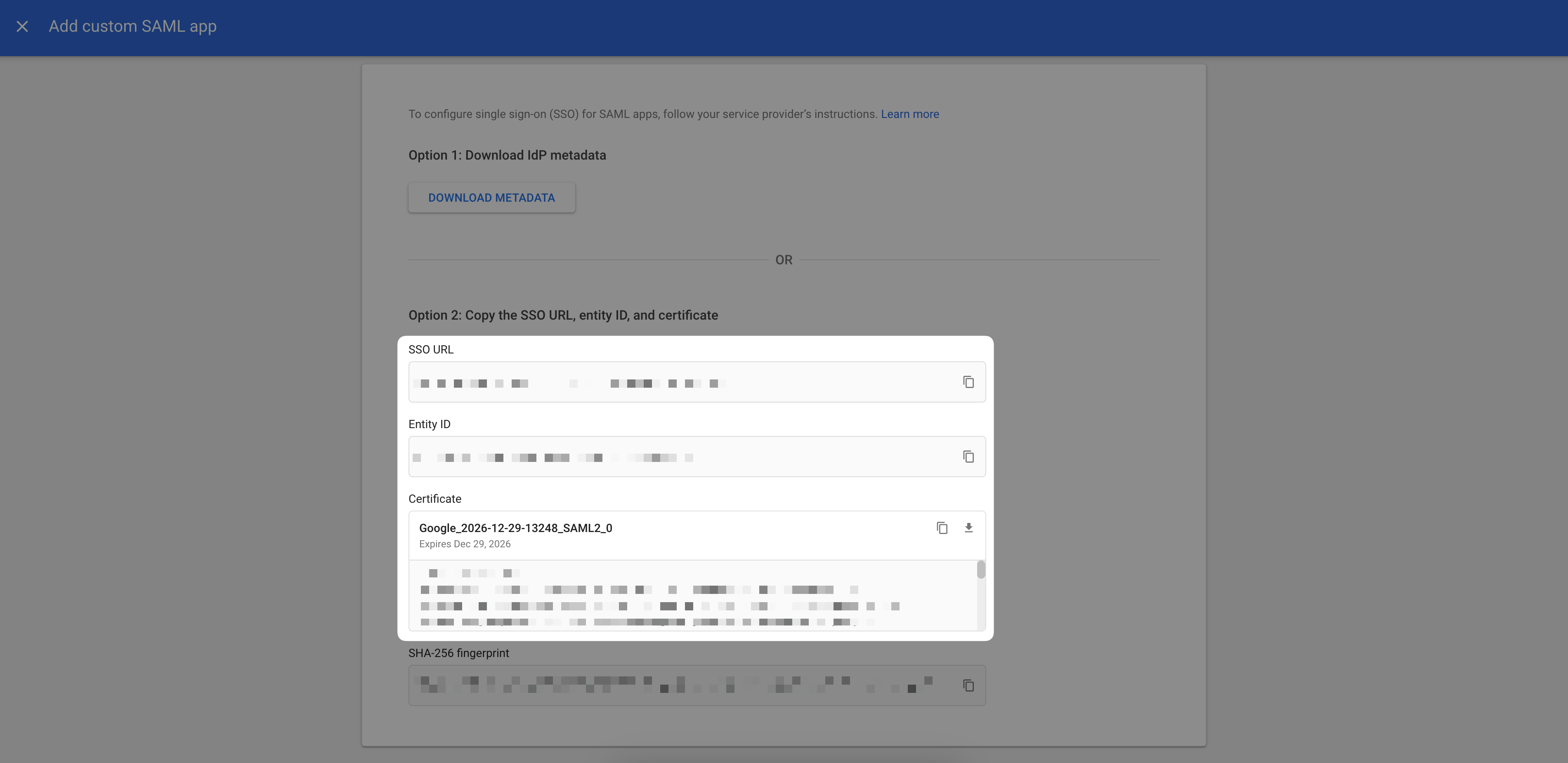
Configure integration
On the Service provider details page, enter the following: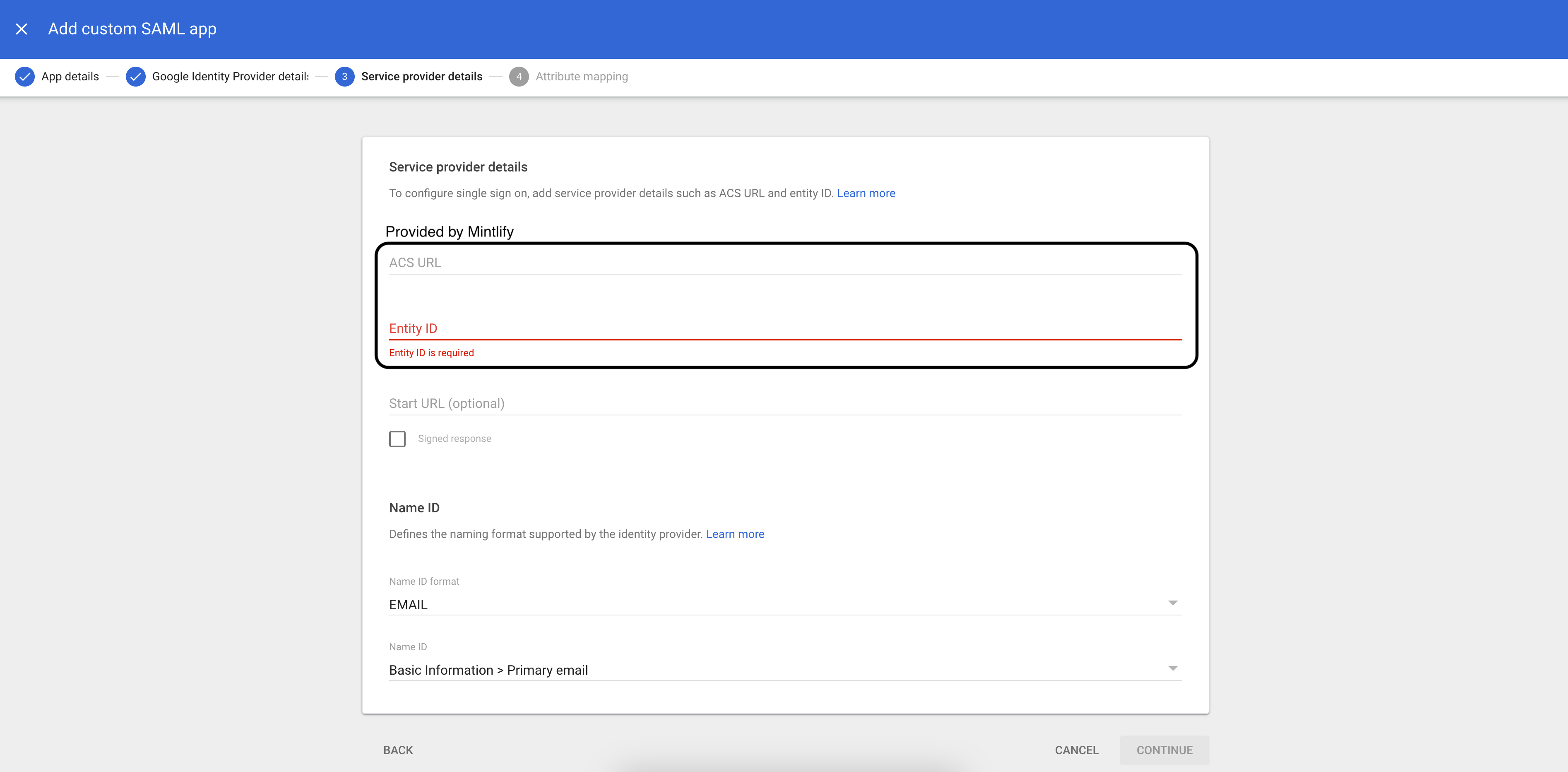
Once this step is complete and users are assigned to the application, let our team know and we’ll enable SSO for your account.
- ACS URL (provided by Mintlify)
- Entity ID (provided by Mintlify)
- Name ID format:
EMAIL - Name ID:
Basic Information > Primary email
| Google Directory Attribute | App Attribute |
|---|---|
First name | firstName |
Last name | lastName |
Okta (OIDC)
Create an application
In Okta, under Applications, create a new app integration using OIDC. Choose the Web Application application type.
Configure integration
Select the authorization code grant type and enter the Redirect URI provided by Mintlify.